
Gage County Court Records After Arrest
Arrest and jail records are not the same as Gage County court records after arrest. The sheriff's current-inmates roster is built for custody. It can show a name, booking charge text, booking date, booking image, and the county where the person is held. That is useful, but it is not the court file. The court record begins when a complaint, information, indictment, traffic or criminal filing, or other charging document is entered in county or district court.
The Gage County Attorney is the local prosecutor for most state and county criminal matters. Nebraska counties use the title County Attorney, not district attorney. When prosecution moves forward, that office may file the same charge listed at booking, file a changed charge, add a new count, reduce a count, or decline to file. For the custody side, use jail inmate records. For booking photos and roster images, use jail mugshots. For filed charges, hearings, and dispositions, use the court systems below.
Gage County Court Case Sources
Gage County Court is the local court contact listed by the Nebraska Judicial Branch. The court is at 612 Grant Street, Room 17, Beatrice, NE 68310. The listed phone number is 402-223-1323, the fax number is 402-223-1374, and regular office hours are 8:00 am to 5:00 pm Monday through Friday. The listed county court judge is Hon. Jeffrey A. Gaertig, and the clerk is Sherri Ullman. The courthouse address is not the jail address, which matters when a person is trying to ask about a case rather than a booking.
Nebraska's JUSTICE system is the statewide search path for county and district court cases. It covers criminal, civil, traffic, juvenile, and probate cases filed in all 93 county and district courts. The one-time party-name search costs $17, returns up to 30 records, and keeps completed search details available for three calendar days. The system reports a 24-hour lag between a case being entered and the case becoming searchable, so a very recent arrest may not have a visible case right away.
Nebraska's JUSTICE case search is the statewide portal identified in the research for finding filed court cases after a Gage County arrest.
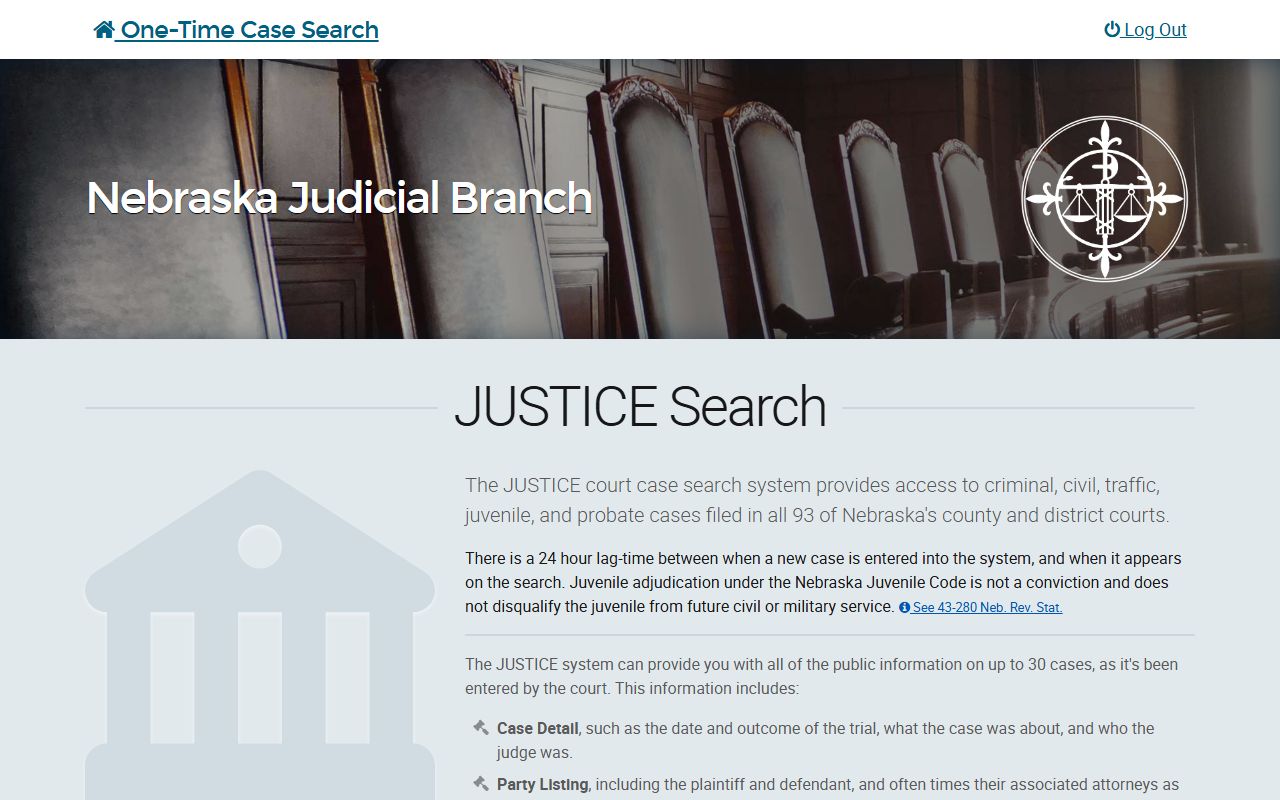
The search page is useful after a case has been entered, but it should be read with the roster and court-calendar tools because each system answers a different question.
| Field Label | Type | Required | Notes |
|---|---|---|---|
| Party name | Text | Yes for one-time party search | Use the defendant's name, not a witness name. |
| Court type | Dropdown or filter | Optional | County court and district court are the main local filters. |
| Case type/subtype | Dropdown or filter | Optional | Use criminal or traffic when narrowing from a jail arrest. |
| County | Dropdown or filter | Optional | Select Gage for local filings. |
| Year | Text or dropdown | Optional | Helpful when the name is common. |
| Judge | Text or dropdown | Optional | Use only when the assigned judge is known. |
| Attorney | Text | Optional | Can narrow attorney-related searches. |
| Begin Search | Button | N/A | The one-time search requires terms acceptance and payment. |
Find Court Records After Arrest
A practical search starts with the custody facts, then moves to the court record. The roster charge text can be useful for spelling and context, but the filed court charge controls the case. Gage's public roster also has a local wrinkle: the "County Held In" field may show Gage, Washington Kansas, Washington KS, Washington NE, RTC-Lincoln, or another entry. Physical custody can differ from the court that owns the case.
- Read the current-inmates entry for name spelling, booking date, charge text, and county-held-in status.
- Allow for the JUSTICE lag if the arrest is new. A case may not appear until after court entry and system update.
- Search JUSTICE by defendant name, then narrow to Gage County and criminal or traffic case type when needed.
- Open the case result and review the party listing, offense information, financial information, register of actions, and images if available.
- Use the Nebraska court calendar when the question is the next hearing date, not the full case record.
- Contact Gage County Court for older files, courthouse kiosk access, or records that do not appear online.
Nebraska's multi-court calendar search is the separate calendar tool for hearing dates by county, court, date, or last name.
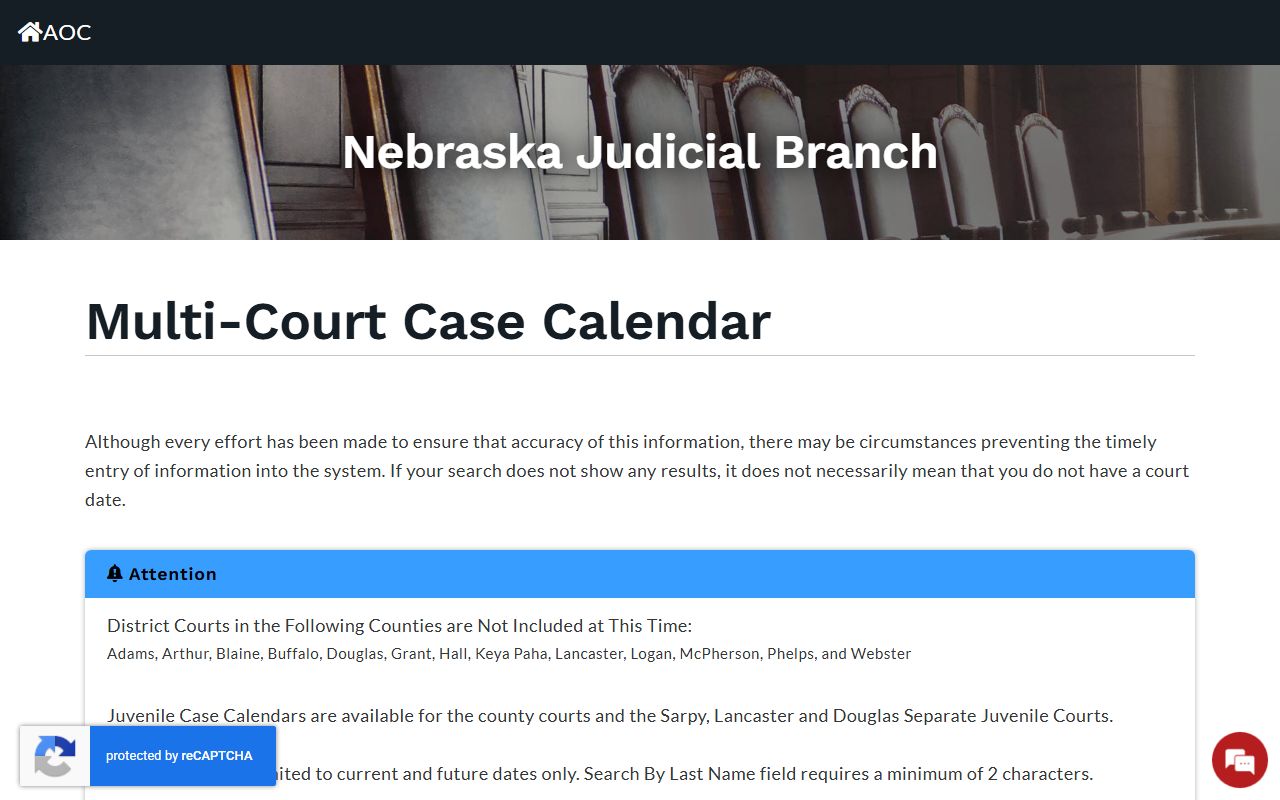
The calendar can confirm a scheduled appearance, but it does not replace a case record because it may not show the full charge history, bond actions, or disposition.
Gage County Charging Documents
The charge record starts with a filing, not with the jail list. A complaint, information, indictment, or traffic/criminal filing is the document that brings the accusation into court. Each filing can change the meaning of the roster charge. A person booked for one listed offense may later face a more precise court count, a reduced count, a dismissed count, or no filed count at all. That is why Gage County court records after a jail arrest should be checked before treating a booking charge as the active court charge.
| Document | Who Files It | Common Use | Record Effect |
|---|---|---|---|
| Complaint | Prosecutor or law enforcement path through court | County court criminal or traffic matters | Starts the court case and states the charge. |
| Information | Prosecutor | Many felony prosecutions after review | Sets out the formal felony counts pursued by the state. |
| Indictment | Grand jury | Serious or grand-jury matters | Begins or supports prosecution through grand-jury action. |
| Amended filing | Prosecutor, with court process | Corrected, reduced, added, or changed counts | Changes the live charge list shown in the court case. |
Charge Status In Gage Court Records
Charge status is the part of the court record that shows where each accusation stands. It is common for the first roster wording to differ from the court wording because the jail lists booking information while the prosecutor applies charging judgment. A pending charge is still unresolved. An amended charge has been changed. A dismissed charge no longer moves forward in that case. A conviction requires a guilty plea, no contest plea accepted by the court, or a verdict.
| Status | What It Means | Why It Matters After Arrest |
|---|---|---|
| Pending | The charge is active and has not reached a final outcome. | The person is accused, not convicted. |
| Amended | The charge text, count, level, or statute basis changed. | The filed case no longer matches the first roster wording. |
| Reduced | The charge was lowered to a less serious count or level. | Final exposure and case handling may change. |
| Dismissed | The count was ended by court action. | The arrest history may still exist, but the charge did not end in conviction. |
| Disposed | The count has a final court outcome. | Review the disposition to see whether it was conviction, dismissal, or another result. |
Bond And Release Records
Bond and release information often sits between the jail and court systems. The Gage roster does not display bond amount or type, so a person checking release must confirm directly with the Sheriff's Office or the court. Nebraska law requires county court judges to adopt bail schedules for misdemeanor offenses and other offenses they deem necessary. A defendant who cannot meet release conditions and remains in custody more than 24 hours after first appearance must be advised about review of those conditions under Nebraska law.
Gage County's official bond page says payments to the Sheriff's Office may be made by credit or debit card through GovPayNet, online at GovPayNow.com, by phone at 1-888-604-7888, or on site. The cardholder pays a service fee. Before money is paid, confirm the current bond, whether the person is physically in Gage County Detention Center or an overflow jail, and whether any other hold prevents release.
The Gage County Sheriff's Office bond page identifies GovPayNet and GovPayNow options for inmate bonds and other sheriff-office payments.

The payment page supports the local bond workflow, but it does not replace a current bond confirmation from the jail, court, or attorney before payment.
Gage County Arrest Warrants
Warrants are a frequent bridge between court records and a new jail arrest. The Gage County Sheriff's Office publishes an outstanding-arrest-warrant list. The observed list included name, photo or photo date, race/sex, date of birth, agency, and charge fields, plus agency and charge abbreviation legends. It also instructs a person who finds their own name to contact the Sheriff's Office to learn what to do to take care of the warrant. Tips can go to the Sheriff's Office, Crime Stoppers, or the sheriff email address listed in the research.
Not every bench warrant or lower-court warrant should be expected to appear instantly and fully on the sheriff list. Court records, JUSTICE, and the Gage County Court clerk may be needed when the warrant comes from missed court, unpaid fine and costs, probation action, or another case event. Do not rely on website text alone before appearing at a jail or courthouse. Confirm the warrant, bond terms, and appearance terms first.
The Gage County arrest-warrants list is the official sheriff source for public outstanding warrant entries.
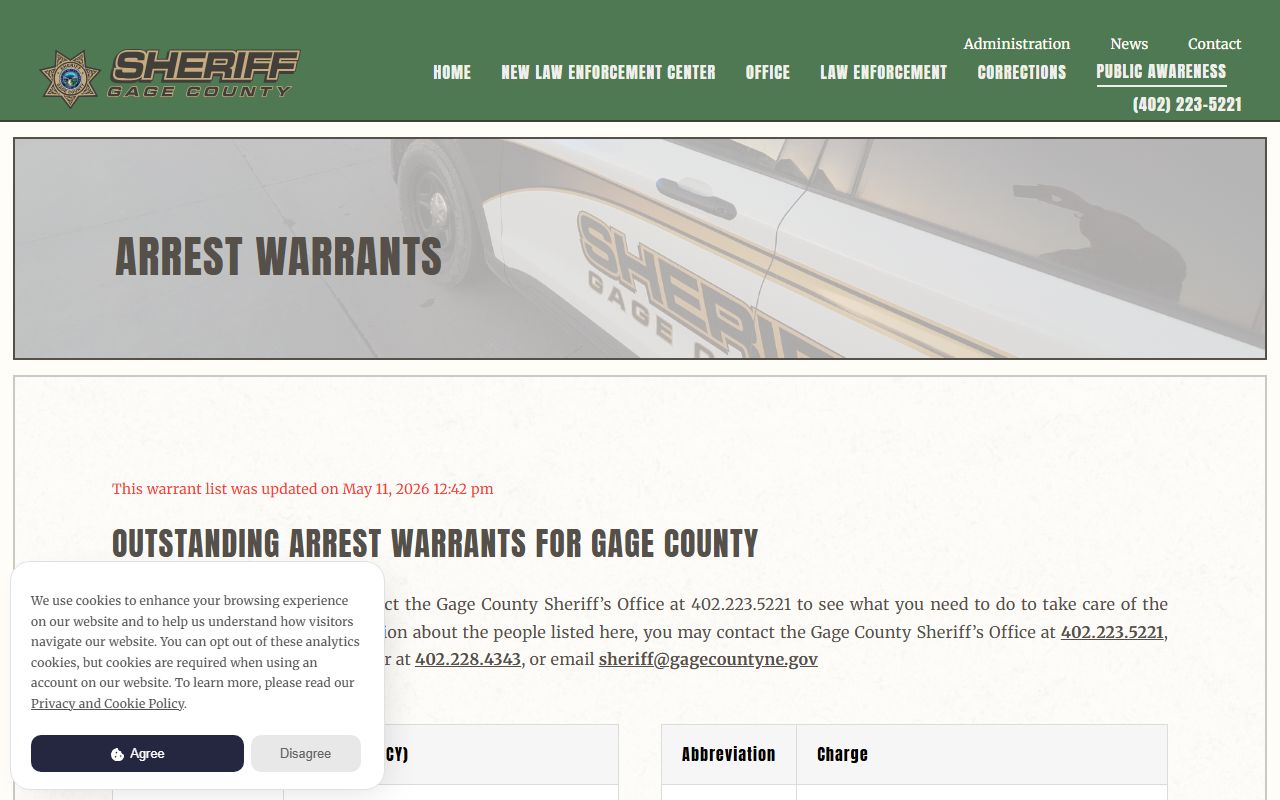
The warrant list can explain why a person was booked, but the later court record still controls the filed charge and case outcome.
Gage County Attorney Role
The County Attorney's office is at 612 Grant St., Room 21, Beatrice, NE 68310. The listed attorney is Amanda Fanning, with phone 402-223-1344, fax 402-223-1380, and office hours from 8:00 a.m. to 5:00 p.m. Monday through Friday, open through lunch and closed weekends and holidays. The county page describes the office's duty, within constitutional, statutory, and caselaw limits, to prosecute or defend civil or criminal suits in which the state or county is a party or interested.
For court records after a jail arrest, the County Attorney is the office that turns arrest facts into filed criminal charges when prosecution proceeds. The office also appears before magistrates, conducts criminal examinations, prosecutes certain civil suits involving the state or county, advises county officials, and performs county coroner duties ex officio. Programs listed by the county include Victim/Witness Assistance Unit, Special Investigations, Diversion, Bad Checks, and Child Support Enforcement. Victim notification can also involve Nebraska's Victims of Crime Alert Portal.
The Gage County Attorney page gives the local prosecutor contact block and describes the office's criminal and civil duties.
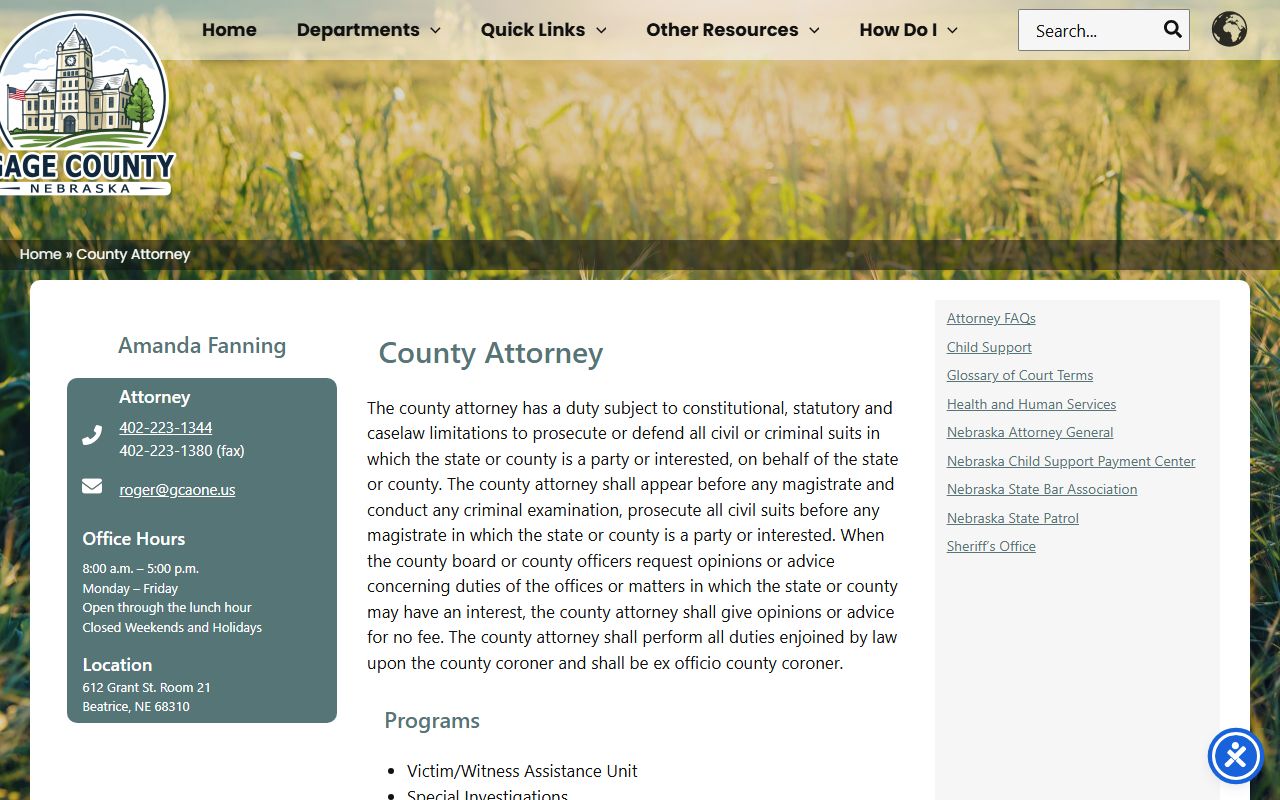
The prosecutor page helps identify the filing office, while the court record remains the place to confirm what charges were actually filed.
Charges, Convictions, Sealed Records
A jail arrest, a filed charge, and a conviction are different records. A charge is an accusation in the court case. A conviction is a final result based on a plea or verdict. Nebraska's public-records statutes broadly allow access to public records unless another law makes a record nonpublic, but records can be withheld or redacted under statutory exceptions, juvenile rules, sealed-record law, security limits, and investigative limits.
| Issue | Charge | Conviction |
|---|---|---|
| Stage | Accusation filed in court | Final result after plea or verdict |
| Proof level | Not proof of guilt | Based on a court-accepted outcome |
| Roster link | May differ from booking wording | May not appear on a current jail roster |
| Use caution | Check status and amendments | Read sentence, fines, probation, and appeal entries |
Neb. Rev. Stat. 29-3523 is relevant to sealing certain criminal-history records and cases. Sealing limits public visibility. Expungement, where available under a specific law, is different and may treat a record as removed or unavailable for broader public use. Do not assume dismissal makes every related record vanish. The case record, arrest record, booking photo, warrant entry, and criminal history can have different rules.
| Issue | Sealed | Expunged |
|---|---|---|
| Public visibility | Hidden or restricted from ordinary public access | Removed or treated under the controlling expungement law |
| Agency access | May remain available to courts or justice agencies in limited ways | Depends on the exact law and order |
| Local effect | Can affect old case visibility in public court searches | Does not create a general right to delete every reposted image |
| Next step | Review the order and court record | Use the order when asking a custodian to update records |
Important: Jail, court, and warrant data should not be used for employment, tenant screening, credit, insurance, or another FCRA-covered decision.
Restricted Gage Court Records
Nebraska public records law starts with access, but access is not unlimited. Neb. Rev. Stat. 84-712 and 84-712.01 define the broad right to inspect public records and obtain copies unless another statute says otherwise. Neb. Rev. Stat. 84-712.05 lists records that may be withheld. For Gage County court records after a jail arrest, the main limits are juvenile confidentiality, sealed cases, ongoing investigations, security-sensitive jail material, confidential victim information, and records controlled by another agency.
County jail records also do not cover every custody system. The Gage roster excludes juvenile offenders and DHS/ICE administrative detainees. A state-prison transfer belongs in Nebraska Department of Correctional Services records. Federal sentenced prisoners are searched through the Federal Bureau of Prisons locator, while federal pretrial and immigration custody can involve limited public access. When the arrest record, court record, and custody record disagree, confirm with the office that created the record.